


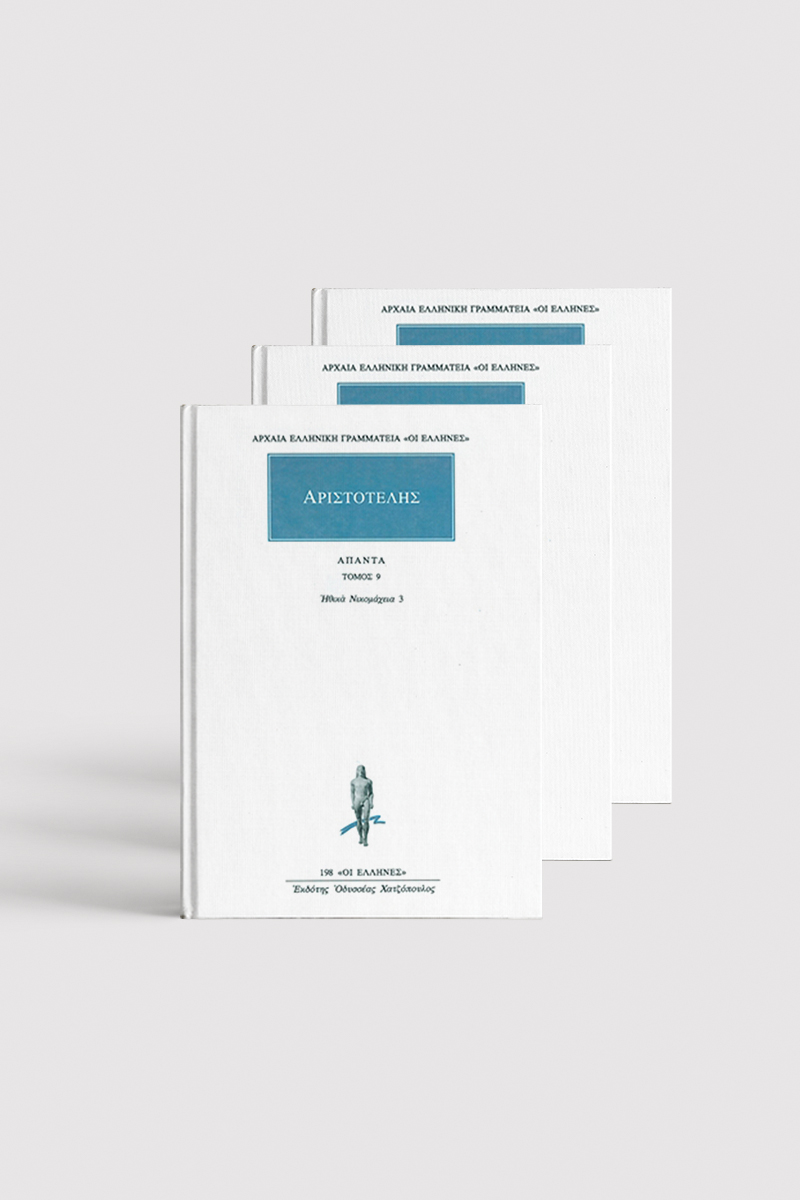
Nikomachean Ethics (3 volumes)

Original price was: 57,49 €.25,90 €Current price is: 25,90 €.
Previous lowest price was 25,90 €.
Ο δρόμος της ευτυχίας σύμφωνα με τον Αριστοτέλη.
Τα «Ηθικά Νικομάχεια» είναι από τα σημαντικότερα και πιο θεμελιώδη έργα της δυτικής φιλοσοφίας. Εξακολουθεί ακόμα και σήμερα να διαδραματίζει σημαντικό ρόλο στη σύγχρονη φιλοσοφική σκέψη και την ηθική θεωρία.
Κείμενο απαραίτητο για την κατανόηση της ηθικής φιλοσοφίας και της ιστορίας της ηθικής, παράλληλα είναι ένας πολύ πρακτικός οδηγός για την κατάκτηση της ευδαιμονίας για τον σημερινό άνθρωπο.
- Description
Description
The Nicomachean Ethics is Aristotle’s important and ever-relevant work on moral teaching. It is the work in which the great philosopher poses and examines the question: “What is it that makes a person truly happy?”
The Nicomachean Ethics is a work of moral philosophy and ethical instruction. Its subject matter focuses on the concepts of the “good and virtuous life,” moral virtue, justice, and happiness, as defined by this preeminent thinker.
In the Nicomachean Ethics, Aristotle develops the doctrine of the mean, according to which the right measure lies between two extremes. Thus, courage is defined as avoiding both cowardice and recklessness; temperance is achieved by finding the middle ground between insensibility and debauchery; and generosity is the mean between stinginess and wastefulness.
The Happy Life
Aristotle declares that the good and virtuous life is also a happy life. He calls happiness (eudaimonia) “the highest of all practical goods”—that is, the supreme good humans can achieve through their actions (a form of individual eudaimonism). According to Aristotle, human beings can attain happiness through intellectual and moral virtues: the intellectual virtues are acquired through teaching, while the moral virtues arise through practice and habituation. Therefore, for Aristotle, happiness is a state that all people can achieve, since all are capable of learning and training themselves.
The Division of the Soul
From the very first book, the reader is introduced to Aristotle’s view of the division of the soul. The human being functions in two ways:
a) according to reason, and
b) in ways that have no relation to reason.
The Concept of Justice
In the Nicomachean Ethics, Aristotle focuses extensively on justice and related notions. It is no coincidence that the later separation of powers in all forms of political systems finds its roots in Aristotle and in this very treatise.
He distinguishes between:
-
Distributive justice,
-
Corrective justice, and
-
Reciprocal justice.
Aristotle also differentiates between natural law and positive (or legal) law. The latter is a product of human initiative, expressed through laws, while the former is unwritten and self-evident.
In the conflict between justice and injustice, Aristotle identifies equity (epieikeia) as the central virtue that should guide us in addressing possible contradictions or gaps in positive law.
The Nicomachean Ethics is a bundle of three volumes that includes the ancient Greek text, a Modern Greek translation, introduction and commentary.
RELATED ITEMS
-

Parallel Lives (24 volumes)
Original price was: 379,70 €.265,79 €Current price is: 265,79 €.Previous lowest price was 265,79 €.
-
Complete Works of Dionysius of Halicarnassus (19 volumes)
Original price was: 337,50 €.202,50 €Current price is: 202,50 €.Previous lowest price was 202,50 €.
-

Diophantus Complete Works (5 volumes)
Original price was: 91,80 €.64,26 €Current price is: 64,26 €.Previous lowest price was 64,26 €.
-

Poseidonius Complete Works (3 volumes)
Original price was: 64,30 €.45,01 €Current price is: 45,01 €.Previous lowest price was 45,01 €.
-

History of Animals (4 volumes)
Original price was: 78,50 €.47,10 €Current price is: 47,10 €.Previous lowest price was 47,10 €.
-

Commentary on Plato’s Republic (6 volumes)
Original price was: 123,10 €.73,86 €Current price is: 73,86 €.Previous lowest price was 73,86 €.
-

Nutrition and Health Collection (6 volumes)
Original price was: 119,70 €.71,82 €Current price is: 71,82 €.Previous lowest price was 71,82 €.
-

ANCIENT GREEK MATHEMATICS COLLECTION
Original price was: 760,90 €.550,00 €Current price is: 550,00 €.Previous lowest price was 550,00 €.
-

Moralia
Original price was: 601,20 €.400,00 €Current price is: 400,00 €.Previous lowest price was 400,00 €.
-

Aristotle’s Physics (4 Volumes)
Original price was: 83,10 €.58,17 €Current price is: 58,17 €.Previous lowest price was 58,17 €.
Μπορεί επίσης να σας αρέσουν
-

Ανθοκλοπή
Original price was: 9,90 €.8,91 €Current price is: 8,91 €.Previous lowest price was 8,91 €.
-

OΔΥΣΣΕΙΑ – Ο δρόμος της επιστροφής
Διαθέσιμο για προπαραγγελίαOriginal price was: 18,79 €.16,91 €Current price is: 16,91 €.Previous lowest price was 16,91 €.
-

ΣΕΙΡΑ Ιωάννης Α. Καποδίστριας
Original price was: 50,19 €.30,71 €Current price is: 30,71 €.Previous lowest price was 30,71 €.
-

Σκάσε, εγώ μιλάω τώρα
Original price was: 27,70 €.24,93 €Current price is: 24,93 €.Previous lowest price was 24,93 €.
-

Στην καρδιά μου γράφει Ελλάδα
Original price was: 12,19 €.10,98 €Current price is: 10,98 €.Previous lowest price was 10,98 €.