


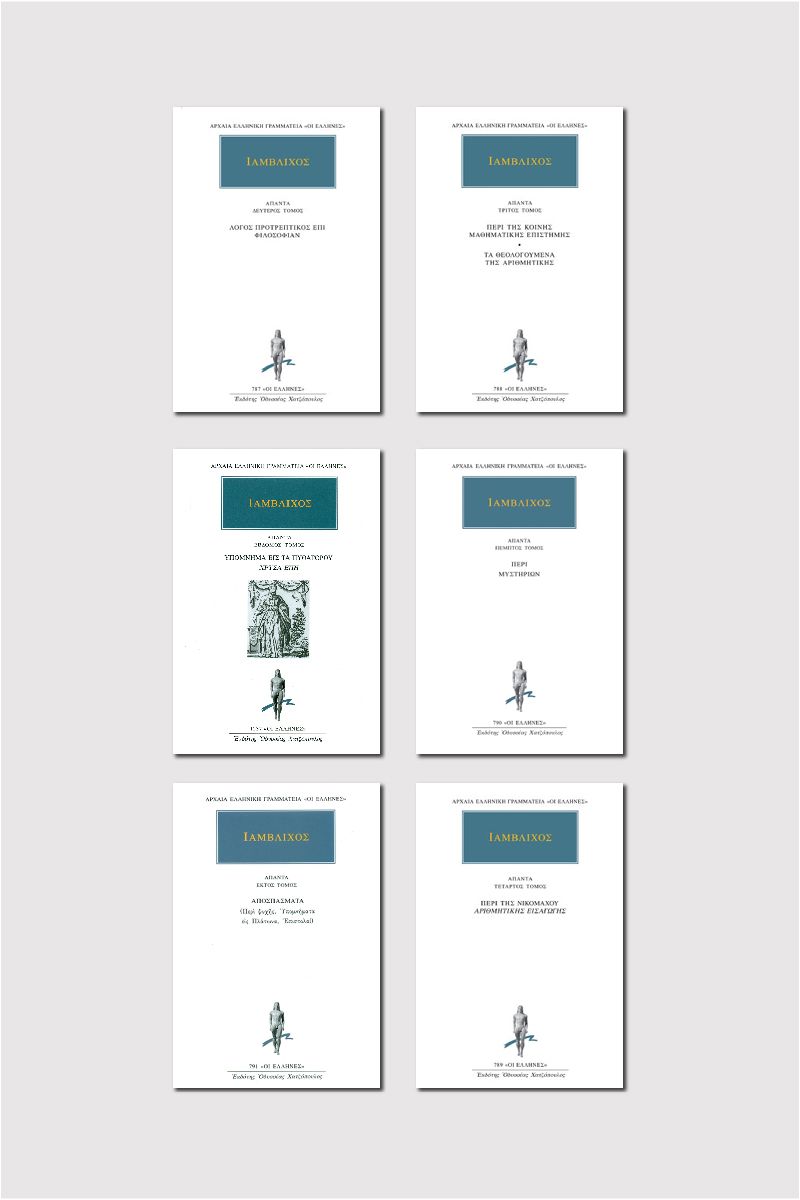
Iamblichus Complete Works (7 Volumes)
Original price was: 146,30 €.102,41 €Current price is: 102,41 €.
Previous lowest price was 102,41 €.
- Description
Description
Iamblichus is one of the most important representatives and shapers of Neoplatonic philosophy. He was a student of Anatolius and Porphyry in Rome, where the two philosophers directed Plotinus’ Neoplatonic school. A leading figure of the Syrian Neoplatonic school, mystic and mathematician, Iamblichus became especially known as the biographer of Pythagoras, whose philosophical work he studied extensively.
The collection includes the following works, in seven volumes:
-
On the Pythagorean Life: A biography of the great philosopher Pythagoras written by Iamblichus.
-
Commentary on Pythagoras’ “Golden Verses”: This work by Iamblichus, preserved in an Arabic epitome and translated and published in Greek for the first time, was discovered relatively recently and is not widely known in international bibliography. It presents Iamblichus’ interpretation of each verse of Pythagoras’ Golden Verses and is of exceptional interest, as it adds significant and new information for forming a more complete picture of the philosophy of this great Neoplatonic thinker.
-
Exhortation to Philosophy (Protrepticus): Based on the lost Protrepticus of Aristotle, the Platonic dialogues, and the also lost Protrepticus of an unknown sophist of the 5th/4th century BC, Iamblichus develops arguments on the usefulness of engaging in philosophy. At the end, he provides a list of the main Pythagorean precepts and their interpretation.
-
On the Common Mathematical Science: In this work, Iamblichus seeks to describe the principles, nature, and usefulness of general mathematical science, which includes all its branches—arithmetic, geometry, music/harmony, and astronomy. At the same time, he emphasizes the intermediate ontological character of this science, which makes it essential for understanding both the higher world of Ideas and the lower physical world in which we live.
-
The Theology of Arithmetic: The only surviving work of arithmetical theology from antiquity. In it, Iamblichus describes the theological properties that the Pythagoreans mainly attributed to the first ten numbers.
-
On Nicomachus’ Introduction to Arithmetic: In interpreting the Introduction to Arithmetic by the Pythagorean philosopher Nicomachus, Iamblichus provides a wealth of information about the science of numbers, unknown from other sources. Thus, this commentary essentially forms a new, original introduction to mathematical science. The appearance of zero among numbers, the method of solving systems of equations known as the Thymarides blossom, and the generation of square and oblong numbers through the recursive addition of successive numbers—all belong to the achievements of ancient mathematics known only through this work of Iamblichus.
-
On the Mysteries: In this theurgical treatise, Iamblichus discusses Greek and Eastern wisdom, the soul, the distinctions among higher beings, divination and divine inspiration, daimones, sacrifices, the symbolism of Egyptian mysteries, Egyptian theology, happiness, fate, and the Good—a work that had great influence on later philosophy.
-
Fragments: Fragments of Iamblichus’ works that do not survive complete:
-
On the Soul (on the nature and activities of the soul, judgment, punishment, and purification after its separation from the body),
-
Commentaries on Plato (interpretations of Platonic dialogues, especially the Timaeus),
-
Letters (letters to his friends and students discussing topics such as fate, dialectic, virtues, the education of children, marriage, etc.).
-
Translation in Modern Greek, introduction, and commentary.
RELATED ITEMS
-
Trails of Thought
INTERMEDIATE / EVOLUTIONOriginal price was: 3.209,66 €.2.182,56 €Current price is: 2.182,56 €.Previous lowest price was 2.182,56 €.
-

Paradoxographers Collection (4 volumes)
Original price was: 76,30 €.30,52 €Current price is: 30,52 €.Previous lowest price was 30,52 €.
-

Plato’s Republic (5 volumes)
Original price was: 86,31 €.34,90 €Current price is: 34,90 €.Previous lowest price was 34,90 €.
-
The Suda Collection (8 Volumes)
Original price was: 159,20 €.63,68 €Current price is: 63,68 €.Previous lowest price was 63,68 €.
-
Nikomachean Ethics (3 volumes)
Original price was: 57,49 €.25,90 €Current price is: 25,90 €.Previous lowest price was 25,90 €.
-
Presocratics Collection (20 volumes)
Original price was: 319,00 €.129,90 €Current price is: 129,90 €.Previous lowest price was 129,90 €.
-

Introduction to ancient Greek philosophy (8 volumes)
Original price was: 142,90 €.85,74 €Current price is: 85,74 €.Previous lowest price was 85,74 €.
-

Commentary on Plato’s Timaeus
Original price was: 186,40 €.111,84 €Current price is: 111,84 €.Previous lowest price was 111,84 €.
-

ANCIENT GREEK MATHEMATICS COLLECTION
Original price was: 760,90 €.550,00 €Current price is: 550,00 €.Previous lowest price was 550,00 €.
-

Moralia
Original price was: 601,20 €.400,00 €Current price is: 400,00 €.Previous lowest price was 400,00 €.